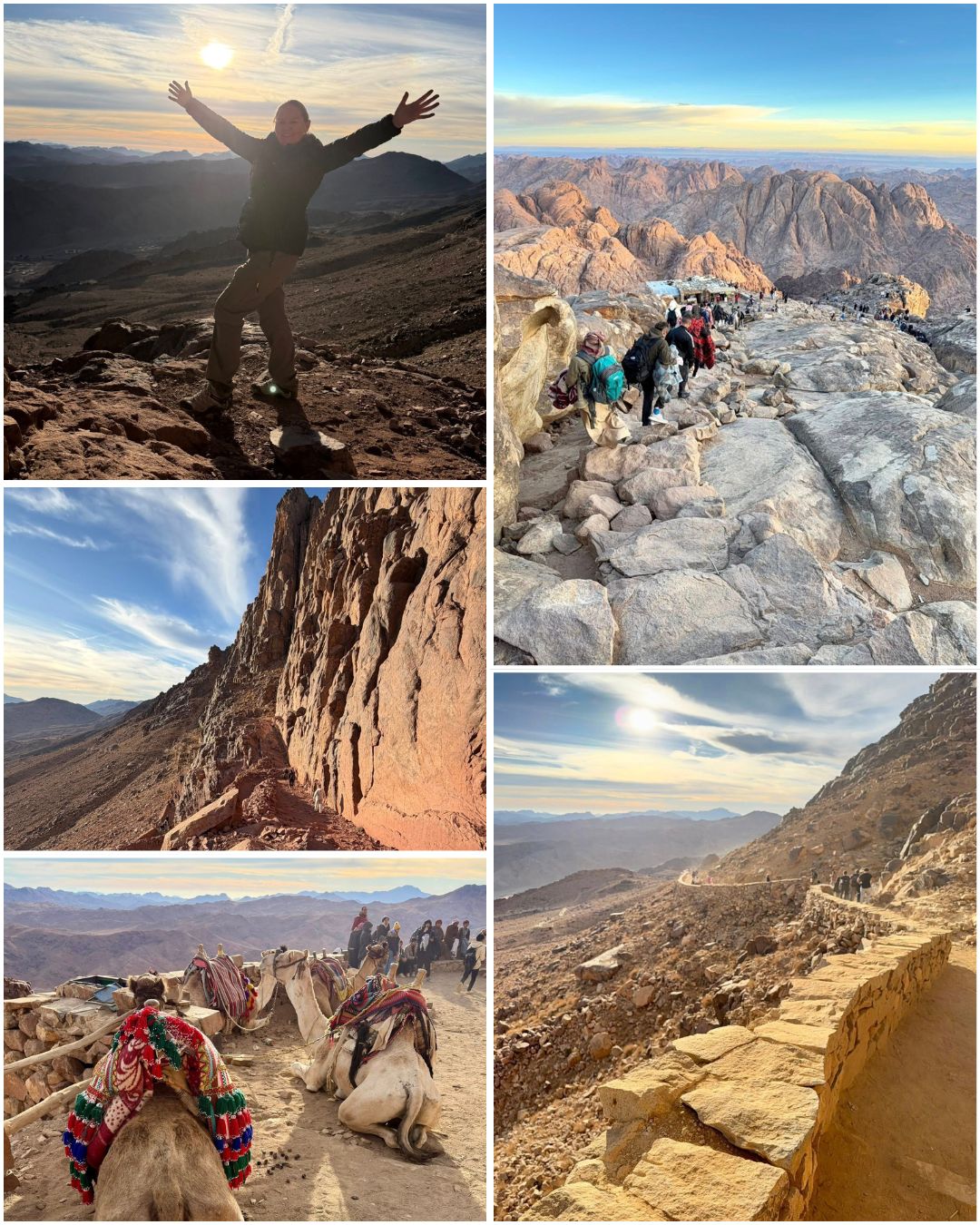
A three-hour late-night drive through the black Sinai desert led to a night that felt part circus, part pilgrimage, and part private communion with the stars. The hike up Mount Sinai turned out to be far more crowded, colorful, and magical than expected, yet somehow it still became an amazingly intimate, personal journey. The evening began with a three-hour drive from the coast where the resorts are into the interior of the Sinai Peninsula, headlights carving a path through endless desert and the dark silhouettes of distant mountains. What I thought sounded like a remote, almost secret pilgrimage quickly turned into something much bigger as the road filled with tour buses heading in the same direction.By the time the convoy approached the mountain area, it was shocking how many buses were lined up ahead, each one packed with travelers who had also decided that hiking a desert mountain in the middle of the night was a great idea. Onboard and at the rest stops, the mix of nationalities became clear: large Russian groups, plus travelers from places as varied as Ghana, Italy, Mongolia, Finland, and Uzbekistan, all funneling toward the same iconic peak. Somewhere along that dark highway, the buses pulled into a makeshift roadside market that seemed to exist solely for Mount Sinai pilgrims. Stalls offered cigarettes, instant coffee, and simple snacks under harsh fluorescent lights, with a few basic but thankfully clean toilets doing brisk business before the ascent. The scene felt like a surreal crossroads: sleepy travelers wrapped in layers, Bedouin vendors chatting, so many people smoking, and the rumble of engines ready to push deeper into the desert night. This improvised stop was a reminder that, even in remote places, tourism builds entire micro-economies to support fleeting waves of visitors. The Bedouin and local workers have adapted to serve the nightly flow of hikers, turning what might have been a forgotten roadside into a small hub of commerce and human interaction. Arriving at the base of Mount Sinai, the crowds multiplied again: parking lots choked with buses, groups gathering under dim lights, and guides organizing their clusters of hikers in every language imaginable. Before setting off, everyone passed through Egyptian police control, where officers checked bags for alcohol with particular attention to the Russian groups, even opening and sniffing water bottles to be sure nothing stronger was hidden inside (as they did at the dive site yesterday—somehow the Russians have quite the reputation…). It added a layer of almost comic bureaucracy to the night: a holy mountain, thousands of pilgrims, and security officers separating real water from disguised vodka. The contrast between the spiritual reputation of the place and the very earthly effort to keep contraband alcohol off the trail made for an unforgettable prelude to the climb. At first, it seemed inevitable that the hike would be spent surrounded by crowds, cigarette smoke, and noisy groups pushing up the same narrow path. Meeting the cheerful local Bedouin guides at the base, the expectation was that this would be a mass procession rather than a peaceful trek.Instead, there was a quiet gift: my amazing DMC (the tour operator I’m working with to plan future Egypt trips) had arranged a private Bedouin guide just for me, transforming the experience from group march to a very personalized journey. With a guide who knew the mountain intimately, he and I were able to slip onto alternate paths, step away from chains of headlamps, and escape the densest clusters of smoking, chatting hikers and loudly shouting groups working their way up in packs. With the private guide leading the way, the route wove in and out of the main Camel Path, stepping onto quieter tracks whenever the crowds became too dense. Even from these side paths, it was impossible not to feel the sheer scale of the nightly pilgrimage: likely over a thousand people tackling the mountain that night, voices drifting up in Russian, Arabic, Italian, and languages from across Africa and Asia. It was almost surreal how rarely English floated through the air, despite the global nature of the crowd. The mountain became a kind of nighttime United Nations, with every language under the sun echoing softly in the dark—yet the personal experience felt increasingly solitary thanks to that one dedicated guide and the choice to walk just off the main stream of people. I literally couldn’t have been luckier to have this private guide and my own completely personal experience.As the trail climbed away from the lights of the parking area, the sky opened in a way that is only possible in dry, high desert air. Above the jagged silhouettes of the Sinai mountains, Orion and Scorpius shone with incredible clarity, their bright stars carving unmistakable shapes into the night. Thousands of stars appeared like pinpricks on velvet, so clear and steady that it felt as though someone had quietly switched on an entire galaxy just for this hike. The silence became almost as striking as the view. Away from the main clusters of hikers, footsteps softened on stone, conversations faded, and the desert seemed to hold its breath. The stillness was as sharp and pure as the cold air, interrupted only by the crunch of gravel, the occasional snort of a camel somewhere on the main trail, and the quiet voice of the Bedouin guide picking out the safest rocks to step on in the dark. The path itself was no gentle stroll: it rose steadily and at times steeply, a rocky ascent that demanded attention with every step. For roughly three hours, the climb wound upward over uneven stones and dusty switchbacks, legs and lungs working steadily in the thin, chilly air (around 5°C / 40°F). Near the top, the slopes of Mount Sinai are notorious for their stone stairways and steeper sections, making the final stretch a determined push rather than a casual walk.Along the way, small Bedouin-run cafeterias punctuated the darkness: simple shelters serving coffee, hot chocolate, hibiscus tea, and chai to cold hikers pausing on the ascent. These warm oases of light and steam added a human rhythm to the trek, turning the climb into a series of stages—walk, rest, sip something hot, look up at the stars, and then step back into the darkness to continue the journey toward the summit. Eventually, we reached the end of the trail and then started up the 750 steps to the very top of the mountain. By the time we reached the end of the trail, it was about 4:30 in the morning.At the top of the mountain there was a small hut filled with thick, heavy handmade blankets you could rent for about four dollars. It was really cold and windy at the summit, so these were very welcome. Everyone was grabbing the blankets and heading out to see if they could claim the best spot to watch the sunrise. It was so cold, and there were literally hundreds of people pushing to find a vantage point. My fabulous Bedouin guide told me to stay behind and hang out in the hut to try and stay warm. It was pretty uncomfortable and chilly, but I nodded off sitting upright just a little bit here and there.Of course, right before sunrise, at about 5:30 a.m., he told me we should go. He knew a secret path to get to a secret spot where we could get amazing views over the mountains and watch the sky in all its orange glory as the sun came up. Since we had hiked up at night in the pitch black, seeing the true beauty and glory of the place in daylight was absolutely incredible—one of the most beautiful places I’ve ever seen in my life. It felt truly spiritual and Biblical. It was amazing to think that we were right where Moses spent 40 days out here in the desert, and where the Ten Commandments came to him, in the exact same spot where we were standing. There is a small chapel there and also a small mosque right next to it, commemorating Moses. We spent about an hour watching the beautiful change in light over the mountains and taking in all of the incredible scenery. Then it was time to head back down the mountain. We went back the same way down the 750 steps and then down the trail—almost 2,500 feet of elevation loss over about 2.5 miles.There were hundreds of camels along the way, with Bedouins offering their “camel taxis” to weary travelers. To me, the poor camels looked far more weary than the people. Ahead, the zigzag of the trail was dotted with tiny moving figures, each step sending small clouds of sand and gravel into the light so the path looked almost hazy. Some hikers moved slowly and carefully, knees aching, while others bounded down in bursts of energy now that the hardest part was over, pausing to turn back for one last look at the sunlit peak. The magic of sunrise slowly faded into the practical business of getting back: jackets were unzipped, headlamps tucked away, and phones and cameras came out again to capture the long line of people snaking toward the valley. Yet there was still a quiet, shared feeling in the group; even with hundreds of hikers on the trail, there were moments when the only sounds were distant footsteps, the wind, and the low murmur of awe that lingers after watching night turn into day from high on the mountain.